👤 📅 Last Updated April 21, 2026
Motor Resistance Calculator
Disclaimer: While we strive to ensure the accuracy of our calculator tools, we cannot be held responsible for any damages or financial losses resulting from their use.
Motor resistance plays an important role in understanding how efficiently a motor operates and how much current it draws under load. If you’re working with electric motors, fixing equipment, or designing winding systems, knowing the resistance value is important. It helps you find overheating and performance problems.
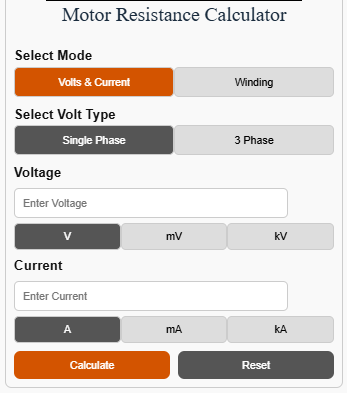
This Motor Resistance Calculator makes it easier to estimate resistance using either voltage and current values or winding properties like wire length and cross-sectional area. It supports both single-phase and three-phase motors, along with common conductor materials used in motor windings.
How to Calculate Motor Resistance
Motor resistance can be calculated using electrical values such as voltage and current, or by using winding properties like wire length and cross-sectional area. Most calculations are based on Ohm’s Law, which relates voltage, current, and resistance in an electrical circuit.
Basic Motor Resistance Formula
The most common formula used to calculate motor resistance is:
R = V / I
- R = Resistance (Ohms, Ω)
- V = Voltage (Volts, V)
- I = Current (Amperes, A)
Example 1: Resistance Using Voltage and Current
Suppose a motor operates at 230 volts and draws 5 amperes of current.
R = 230 / 5
R = 46 Ω
This means the motor winding resistance is approximately 46 ohms.
Motor Resistance in Single Phase Motors
Single-phase motors are commonly used in household appliances, pumps, and small machinery. The resistance of a single-phase motor can be calculated directly using voltage and current values.
Single Phase Formula
R = V / I
Example 2: Single Phase Motor
If a single-phase motor operates at:
- Voltage = 220 V
- Current = 10 A
R = 220 / 10
R = 22 Ω
Therefore, the resistance of the single-phase motor is 22 ohms.
Motor Resistance in Three Phase Motors
Three-phase motors are widely used in industrial applications because they provide higher efficiency and smoother operation. The resistance calculation depends on whether the voltage used is line voltage or phase voltage.
Three Phase Formula (Using Line Voltage)
R = V / (√3 × I)
Where:
- √3 ≈ 1.732
- V = Line Voltage
- I = Line Current
Example 3: Three Phase Motor (Line Voltage)
Given:
- Line Voltage = 415 V
- Current = 8 A
R = 415 / (1.732 × 8)
R = 415 / 13.856
R ≈ 29.95 Ω
So, the resistance of the three-phase motor is approximately 29.95 ohms.
Motor Resistance Using Winding Properties
Motor resistance can also be calculated using the physical properties of the winding wire. This method is useful when designing motors or estimating resistance from wire dimensions.
Winding Resistance Formula
R = ρ × L / A
- ρ = Resistivity of conductor (Ω·m)
- L = Length of wire (meters)
- A = Cross-sectional area (square meters)
Example 4: Winding Resistance
Assume:
- Material = Copper (ρ = 1.68 × 10⁻⁸ Ω·m)
- Length = 50 meters
- Area = 2 mm² (2 × 10⁻⁶ m²)
R = (1.68 × 10⁻⁸ × 50) / (2 × 10⁻⁶)
R = 0.42 Ω
This shows the winding resistance is approximately 0.42 ohms.
Important Notes When Calculating Motor Resistance
- Always measure voltage and current accurately for reliable results.
- Resistance increases slightly as motor temperature rises.
- Three-phase motors require special attention to line and phase values.
- Large motors usually have very low resistance values.
- Use consistent units when performing calculations.
Motor Resistance Calculation Examples
| Motor Type | Voltage (V) | Current (A) | Formula Used | Resistance (Ω) |
|---|---|---|---|---|
| Single Phase | 120 | 4 | R = V / I | 30 |
| Single Phase | 220 | 10 | R = V / I | 22 |
| Single Phase | 230 | 5 | R = V / I | 46 |
| Three Phase | 400 | 6 | R = V / (√3 × I) | 38.49 |
| Three Phase | 415 | 8 | R = V / (√3 × I) | 29.95 |
| Three Phase | 440 | 12 | R = V / (√3 × I) | 21.18 |
| Winding (Copper) | — | — | R = ρL / A | 0.42 |
| Winding (Aluminum) | — | — | R = ρL / A | 0.71 |
| Single Phase | 110 | 3 | R = V / I | 36.67 |
| Three Phase | 380 | 7 | R = V / (√3 × I) | 31.34 |
| Single Phase | 240 | 12 | R = V / I | 20 |
| Three Phase | 480 | 15 | R = V / (√3 × I) | 18.47 |
Frequently Asked Questions
Why is motor resistance usually very low in large motors?
Large motors use thicker winding wires to handle higher current loads. Thicker wires have lower electrical resistance, which reduces heat loss and improves efficiency during operation.
Can motor resistance change during operation?
Yes, motor resistance increases slightly as temperature rises. As windings heat up, their resistance grows, which can affect motor performance and energy consumption.
Screenshot of Calculator:
Reference:
Brushless Motor Winding Resistance
Related Calculators: