👤 📅 Last Updated April 27, 2026
3 Phase Motor Cable Size Calculator
Disclaimer: While we strive to ensure the accuracy of our calculator tools, we cannot be held responsible for any damages or financial losses resulting from their use.
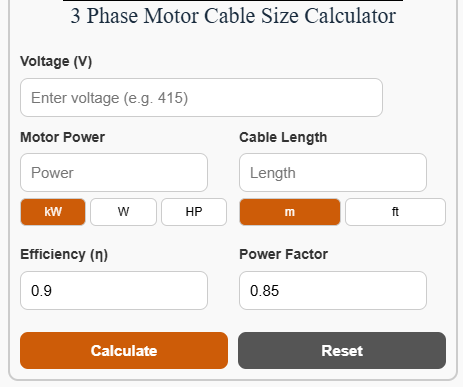
This 3-phase motor cable size calculator determines the correct cable thickness needed to carry motor current without overheating or excessive voltage drop. Selecting the right cable size is essential for protecting equipment, improving motor performance, and avoiding power losses. This tool calculates the motor current using standard electrical formulas. It then suggests an appropriate wire size based on common industry data.
It supports multiple power units like watts, kilowatts, and horsepower. Whether you’re planning a new motor installation or verifying an existing setup, this calculator provides a quick and reliable starting point for cable selection.
How to Calculate 3 Phase Motor Cable Size
This process usually involves calculating the motor current, applying a safety factor, and selecting a suitable cable size based on standard reference values.
Step 1: Calculate Motor Current
The first step is to determine the full-load current of the motor using the standard 3 phase power formula:
Motor Current Formula:
I = (P × 1000) / (√3 × V × PF × η)
- I = Current (Amps)
- P = Motor Power (kW)
- V = Voltage (Volts)
- PF = Power Factor (typically 0.8 to 0.9)
- η = Efficiency (typically 0.85 to 0.95)
- √3 = 1.732 (constant for 3 phase systems)
Step 2: Apply Safety Factor
Motor cables are normally selected using a safety margin to handle starting current and prevent overheating. A common practice is to increase the calculated current by 125%.
Design Current Formula:
Design Current = Motor Current × 1.25
Step 3: Select Cable Size
After calculating the design current, select a cable that has a current rating higher than the calculated value. Standard cable charts are used to match motor current with recommended cable sizes.
Step 4: Check Voltage Drop (For Long Cable Runs)
If the cable length is long, voltage drop must be checked to ensure the motor receives sufficient voltage.
Voltage Drop Formula:
VD = (√3 × I × L × mV) / 1000
- VD = Voltage Drop (Volts)
- I = Current (Amps)
- L = Cable Length (meters)
- mV = Millivolt drop per amp per meter
Typically, voltage drop should not exceed 5% for motor circuits.
Example 1: Basic Calculation
Given:
- Motor Power = 7.5 kW
- Voltage = 415 V
- Power Factor = 0.85
- Efficiency = 0.90
- Cable Length = 30 meters
Step 1: Calculate Motor Current
I = (7.5 × 1000) / (1.732 × 415 × 0.85 × 0.90)
I ≈ 13.6 Amps
Step 2: Apply Safety Factor
Design Current = 13.6 × 1.25
Design Current ≈ 17 Amps
Step 3: Select Cable Size
From standard cable references, a current of 17A typically requires a:
Recommended Cable Size: 2.5 mm² Copper Cable
Example 2: Larger Motor Calculation
Given:
- Motor Power = 22 kW
- Voltage = 415 V
- Power Factor = 0.85
- Efficiency = 0.90
- Cable Length = 50 meters
Step 1: Calculate Motor Current
I = (22 × 1000) / (1.732 × 415 × 0.85 × 0.90)
I ≈ 40 Amps
Step 2: Apply Safety Factor
Design Current = 40 × 1.25
Design Current ≈ 50 Amps
Step 3: Select Cable Size
Based on reference values:
Recommended Cable Size: 10 mm² to 16 mm² Copper Cable
Factors That Affect Cable Size
Several real-world factors influence the final cable selection beyond basic current calculations:
- Motor power rating
- Cable length
- Voltage level
- Power factor
- Motor efficiency
- Installation method (air, conduit, underground)
- Ambient temperature
- Cable material (copper or aluminum)
- Starting current type (DOL, Star-Delta, Soft Starter)
Considering these factors helps ensure reliable motor operation and prevents insulation damage, overheating, and excessive energy loss.
You can also check out this motor cable sizing chart I found on an Instagram post.
Frequently Asked Questions (FAQs)
1. What happens if I use a smaller cable size for a 3 phase motor?
Using a cable that is too small can cause overheating, excessive voltage drop, insulation damage, and reduced motor life. In severe cases, it may lead to motor failure or fire hazards due to overcurrent conditions.
2. Does cable length affect motor cable size selection?
Yes, longer cable lengths increase voltage drop, which may require selecting a larger cable size than the minimum current rating. This helps maintain proper motor voltage and performance.
Related Calculators:
References: