👤 📅 Last Updated April 20, 2026
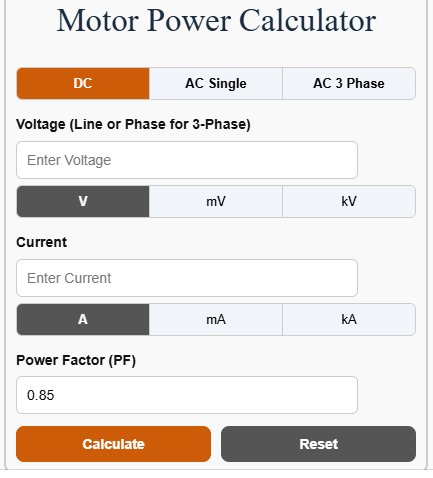
Motor Power Calculator
Result
| Watts (W) | |
| Kilowatts (kW) | |
| Megawatts (MW) | |
| Horsepower (HP) |
Disclaimer: While we strive to ensure the accuracy of our calculator tools, we cannot be held responsible for any damages or financial losses resulting from their use.
This Motor Power Calculator helps you quickly estimate the electrical power of DC, single-phase, and three-phase motors without complex formulas. Whether you’re working on electrical design, motor sizing, or troubleshooting equipment, knowing the correct motor power is essential for safe and efficient operation.
This tool simplifies the process by letting you enter voltage, current, and power factor values in different units, then instantly converts the result into watts, kilowatts, megawatts, and horsepower. It’s especially useful for engineers, electricians, students, and technicians who need fast and reliable power calculations.
How to Calculate Motor Power
To calculate motor power, use a simple formula based on the motor type and key electrical values. For a DC motor, multiply voltage by current. For an AC motor, include power factor—and for three-phase motors, add the √3 factor.
Motor Power Formulas:
Below are the standard formulas used to calculate DC motor power, single phase motor power, and 3 phase motor power, along with examples to help you understand each method.
DC Motor Power Calculation
A DC motor operates using direct current, where voltage and current remain constant. Calculating DC motor power is simple because it does not involve power factor.
DC Motor Power Formula
Power (Watts) = Voltage × Current
Formula:
P = V × I
- P = Power (Watts)
- V = Voltage (Volts)
- I = Current (Amps)
Example – DC Motor Power
Suppose a DC motor operates at:
- Voltage = 220 V
- Current = 12 A
P = 220 × 12
P = 2640 Watts
So, the DC motor power is 2640 W (2.64 kW).
AC Motor Power Calculation
An AC motor uses alternating current and includes an additional factor called power factor (PF). AC motor power calculation depends on whether the motor is single phase or three phase. Power factor accounts for the difference between real power and apparent power in AC circuits.
Single Phase Motor Calculation
A single phase motor is commonly used in homes, small workshops, and light-duty machines. Calculating single phase motor power requires voltage, current, and power factor.
Single Phase Motor Power Formula
Power (Watts) = Voltage × Current × Power Factor
Formula:
P = V × I × PF
- P = Power (Watts)
- V = Voltage (Volts)
- I = Current (Amps)
- PF = Power Factor (typically 0.7 to 0.95)
Example
Assume:
- Voltage = 230 V
- Current = 8 A
- Power Factor = 0.85
P = 230 × 8 × 0.85
P = 1564 Watts
So, the single phase motor power is 1564 W (1.56 kW).
Three Phase Motor Calculation
A 3 phase motor is widely used in industries and heavy machinery because it delivers higher efficiency and smoother operation. The calculation for 3 phase motor power includes a constant value √3 (approximately 1.732).
Three Phase Motor Power Formula
Power (Watts) = √3 × Voltage × Current × Power Factor
Formula:
P = 1.732 × V × I × PF
- P = Power (Watts)
- V = Line Voltage (Volts)
- I = Line Current (Amps)
- PF = Power Factor
Example – 3 Phase Motor
Assume:
- Voltage = 415 V
- Current = 10 A
- Power Factor = 0.9
P = 1.732 × 415 × 10 × 0.9
P = 6475 Watts
So, the three phase motor power is 6475 W (6.48 kW).
Motor Power Conversion to Horsepower (HP)
Motor power is often expressed in horsepower instead of watts, especially in mechanical applications.
Horsepower Conversion Formula
Horsepower (HP) = Watts ÷ 746
Example – Convert Watts to HP
If motor power = 3000 W:
HP = 3000 ÷ 746
HP ≈ 4.02 HP
Calculation Examples Table
| Motor Type | Voltage (V) | Current (A) | Power Factor | Power (W) | Power (kW) |
|---|---|---|---|---|---|
| DC Motor | 120 | 5 | — | 600 | 0.60 |
| DC Motor | 220 | 10 | — | 2200 | 2.20 |
| Single Phase Motor | 230 | 6 | 0.80 | 1104 | 1.10 |
| Single Phase Motor | 240 | 8 | 0.85 | 1632 | 1.63 |
| 3 Phase Motor | 400 | 9 | 0.90 | 5614 | 5.61 |
| 3 Phase Motor | 415 | 12 | 0.88 | 7585 | 7.59 |
| 3 Phase Motor | 440 | 15 | 0.92 | 10512 | 10.51 |
| Single Phase Motor | 220 | 4 | 0.75 | 660 | 0.66 |
| DC Motor | 48 | 20 | — | 960 | 0.96 |
| 3 Phase Motor | 380 | 7 | 0.85 | 3914 | 3.91 |
| Single Phase Motor | 110 | 10 | 0.78 | 858 | 0.86 |
| DC Motor | 24 | 15 | — | 360 | 0.36 |
Frequently Asked Questions
What happens if power factor is ignored in AC motor?
Ignoring the power factor in AC motor calculations can lead to inaccurate results because AC motors do not convert all supplied electrical energy into useful work. Without including power factor, the calculated motor power may appear higher than the actual usable power, which can result in incorrect motor sizing and reduced efficiency.
Why do three phase motors use the 1.732 factor in power calculation?
Three phase motor power formulas include the factor 1.732 because it represents the square root of 3 (√3), which is required when calculating power in balanced three phase electrical systems. This factor accounts for the relationship between line voltage and phase voltage, ensuring accurate total power calculation.