👤 By whycalculator Team 📅 Last Updated April 02, 2026
Falling Object Impact Force
Disclaimer: While we strive to ensure the accuracy of our calculator tools, we cannot be held responsible for any damages or financial losses resulting from their use.
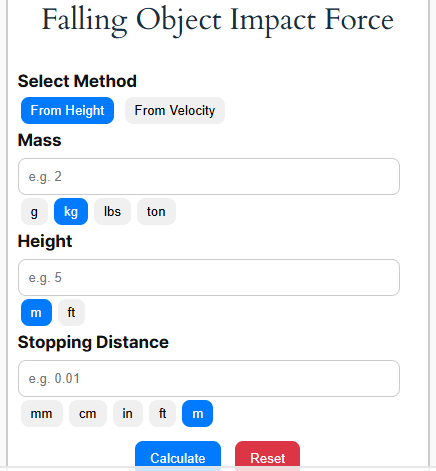
When an object falls from a height, its speed increases due to gravity, and the force it produces on impact can be much greater than expected. This calculator helps explore how that force is created by connecting height, velocity, and stopping distance. Even small changes in how quickly an object comes to rest can drastically change the impact force.
By comparing different methods, you can gain a deeper understanding of the physics behind everyday situations, such as dropping objects or safety design. It also highlights why cushioning materials play an important role in reducing damage and injury.
This tool provides a clearer understanding of how falling impacts behave under real conditions.
How to Calculate Falling Object Impact Force
When an object falls, gravity accelerates it downward, increasing its velocity until it hits a surface. The force generated during impact depends not only on its speed but also on how quickly it comes to a stop. To calculate this force, we typically follow two main steps: first determine the impact velocity, then calculate the force using stopping distance.
Step 1: Calculate Impact Velocity from Height
Formula:
v = √(2 × g × h)
Where:
g = 9.81 m/s² (acceleration due to gravity)
h = height (m)
This formula shows that higher drop height results in greater impact velocity.
Step 2: Calculate Impact Force
Formula (using energy method):
F = (m × g × h) / d
Where:
m = mass (kg)
d = stopping distance (m)
Stopping distance is the distance over which the object comes to rest after impact. Smaller stopping distances produce higher forces.
Example 1: Dropping a Construction Tool
A 3 kg metal tool falls from a height of 4 meters onto a hard concrete surface. The stopping distance is approximately 5 mm (0.005 m).
Step 1: Velocity
v = √(2 × 9.81 × 4)
v = √(78.48)
v ≈ 8.86 m/s
Step 2: Impact Force
F = (3 × 9.81 × 4) / 0.005
F = 117.72 / 0.005
F = 23,544 N
Impact Force ≈ 23,544 N
Example 2: Smartphone Falling on Different Surfaces
A 0.2 kg smartphone falls from 1.5 meters.
On hard floor (d = 1 mm = 0.001 m):
F = (0.2 × 9.81 × 1.5) / 0.001
F = 2.943 / 0.001
F = 2,943 N
On carpet (d = 10 mm = 0.01 m):
F = 2.943 / 0.01
F = 294.3 N
This shows how increasing stopping distance reduces the impact force significantly.
Alternative Method: Using Velocity Directly
Formula:
F = (1/2 × m × v²) / d
This method is useful when the impact velocity is already known (for example, measured or given directly).
Example: Falling Object with Known Velocity
A 2 kg object hits the ground at 10 m/s and stops over a distance of 0.01 m.
Calculation:
F = (0.5 × 2 × 10²) / 0.01
F = (1 × 100) / 0.01
F = 100 / 0.01
F = 10,000 N
Impact Force = 10,000 N
Key Points
- Greater height → higher velocity → higher impact force
- Smaller stopping distance → much larger force
- Soft materials increase stopping distance and reduce damage
- Both formulas give the same result when velocity is derived from height
Falling Object Impact Force Sample Values
| Scenario | Mass (kg) | Height (m) | Velocity (m/s) | Stopping Distance (m) | Impact Force (N) |
|---|---|---|---|---|---|
| Hammer dropped on concrete | 1.5 | 2 | 6.26 | 0.002 | 14,715 |
| Brick falling from wall | 2 | 5 | 9.90 | 0.01 | 9,810 |
| Smartphone on hard floor | 0.2 | 1.5 | 5.42 | 0.001 | 2,943 |
| Smartphone on carpet | 0.2 | 1.5 | 5.42 | 0.01 | 294 |
| Tool dropped from ladder | 3 | 4 | 8.86 | 0.005 | 23,544 |
| Book falling from desk | 0.8 | 1 | 4.43 | 0.003 | 2,616 |
| Metal ball on steel plate | 0.5 | 3 | 7.67 | 0.001 | 14,715 |
FAQs
1. Why does a falling object create such a high impact force?
As an object falls, gravity increases its speed, which increases its kinetic energy. When it hits a surface, this energy must be absorbed over a very short distance or time. If the stopping distance is small, the energy is released quickly, resulting in a very high impact force.
2. How can the impact force of a falling object be reduced?
Impact force can be reduced by increasing the stopping distance or time. This can be done using soft materials like foam, rubber, or airbags that absorb energy and slow down the object gradually, reducing the force of impact.
Related Calculators: