👤 By whycalculator Team 📅 Last Updated March 30, 2026
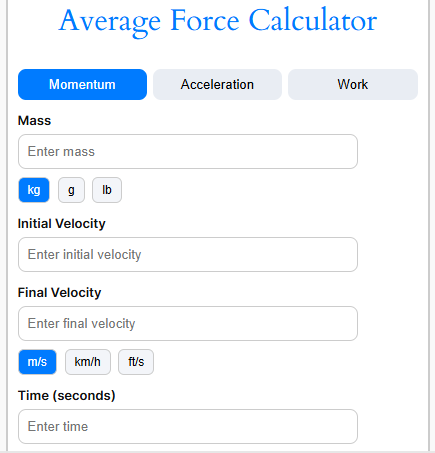
Average Force Calculator
Result
Disclaimer: While we strive to ensure the accuracy of our calculator tools, we cannot be held responsible for any damages or financial losses resulting from their use.
Understanding average force is easier when you see how it relates to motion, energy, and changes in speed. This average force calculator is designed to help you explore these relationships by allowing you to work with various physical situations, such as an object accelerating, slowing down, or moving over a certain distance.
Instead of memorizing formulas, you can use them to see how mass, velocity, time, and distance actually influence force.
It’s especially useful for learning how the same concept can be solved in multiple ways depending on the given data. By trying out different values, you can gain a better understanding of how forces work in real-life situations, such as braking, collisions, or moving along a path.
How to Calculate Average Force
To calculate average force, use the formula Favg = m × Δv / Δt, where mass (m) is in kilograms, change in velocity (Δv) is in meters per second, and time interval (Δt) is in seconds.
For example, a 2 kg object accelerating from 3 m/s to 7 m/s over 2 seconds requires an average force of 4 newtons: (2 kg × 4 m/s) / 2 s = 4 N.
Alternatively, average force can be derived from work or impulse: Favg = Δp / Δt (change in momentum divided by time) or Favg = W / d (work divided by distance).
Use one of these methods to find average force, depending on your known values.
1. Using Change in Momentum (Time-Based Method)
When an object changes its velocity over time, average force can be calculated using:
F = m (vf − vi) / t
- m = mass (kg)
- vf = final velocity (m/s)
- vi = initial velocity (m/s)
- t = time (seconds)
This method is commonly used in problems involving motion, collisions, and acceleration over time.
2. Using Acceleration (Newton’s Second Law)
If acceleration is known, average force can be calculated more directly:
F = m × a
- a = acceleration (m/s²)
This is the simplest method and is widely used in basic physics and engineering calculations.
3. Using Work and Distance (Energy Method)
When distance is given instead of time, average force can be calculated using work:
F = W / d
Since work is related to kinetic energy:
F = ½ m (vf2 − vi2) / d
- d = distance (meters)
This method is useful in braking, stopping distance, and energy-based problems.
Examples of Average Force Calculation
1. Using Momentum (Time-Based)
A 2 kg object increases its velocity from 3 m/s to 9 m/s in 3 seconds. Find the average force acting on it.
Formula: F = m (vf − vi) / t
F = 2 × (9 − 3) / 3
F = 2 × 6 / 3
F = 12 / 3
F = 4 N
2. Using Acceleration
A 5 kg object accelerates at 2 m/s². Calculate the average force.
Formula: F = m × a
F = 5 × 2
F = 10 N
3. Using Work and Distance
A 1.5 kg object moves from rest to 8 m/s over a distance of 4 meters. Find the average force.
Formula: F = ½ m (vf2 − vi2) / d
F = ½ × 1.5 × (8² − 0) / 4
F = 0.75 × 64 / 4
F = 48 / 4
F = 12 N
Real-Life Examples of Average Force
1. Car Braking
When a car slows down from high speed to stop, the braking force acting over time or distance is the average force. Engineers use this to design safe braking systems.
2. Football Kick
When a player kicks a football, the force applied during the short contact time determines how fast and far the ball travels.
3. Hammering a Nail
A hammer applies force to a nail over a very short time. The average force helps determine how deeply the nail is driven into the surface.
4. Airbags in Cars
Airbags increase the time over which a person stops during a collision, reducing the average force and minimizing injuries.
5. Pushing a Box
When you push a box across the floor, the force you apply over a certain distance determines how much work is done and how the box moves.
By choosing the right formula based on the given values (time, acceleration, or distance), you can easily calculate average force in different real-world situations.
Average Force Sample Values Table
| Mass (kg) | Initial Velocity (m/s) | Final Velocity (m/s) | Time (s) | Distance (m) | Method Used | Average Force (N) |
|---|---|---|---|---|---|---|
| 2 | 3 | 9 | 3 | – | Momentum | 4 |
| 5 | – | – | – | – | Acceleration (a = 2 m/s²) | 10 |
| 1.5 | 0 | 8 | – | 4 | Work/Distance | 12 |
| 3 | 2 | 10 | 4 | – | Momentum | 6 |
| 4 | – | – | – | – | Acceleration (a = 3 m/s²) | 12 |
| 2.5 | 1 | 7 | – | 6 | Work/Distance | 10 |
| 6 | 0 | 12 | 6 | – | Momentum | 12 |
| 3.5 | – | – | – | – | Acceleration (a = 1.5 m/s²) | 5.25 |
| 2 | 0 | 6 | – | 3 | Work/Distance | 12 |
| 7 | 4 | 14 | 5 | – | Momentum | 14 |
FAQs
1. What is the easiest way to calculate average force?
The easiest method is using the formula F = m × a when acceleration is known. If acceleration is not given, you can use velocity and time or distance-based formulas depending on the available data.
2. When should I use the distance-based formula for force?
You should use the distance-based method when time is not provided but distance and velocity are known. It is commonly used in situations like braking, stopping distance, or energy-related problems.
Related Calculators: