👤 By whycalculator Team 📅 Last Updated April 01, 2026
Impact Force Calculator
Disclaimer: While we strive to ensure the accuracy of our calculator tools, we cannot be held responsible for any damages or financial losses resulting from their use.
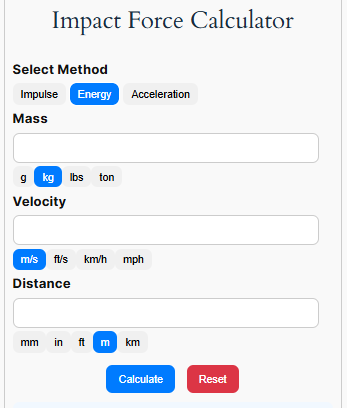
When two objects collide suddenly, the way force works is what makes some impacts feel like a minor bump while others can cause serious damage. This impact force calculator gives a practical way to explore that relationship by connecting motion, mass, and stopping conditions. Whether an object stops instantly or over a short distance makes a huge difference in the force produced.
By using different calculation methods, you can see how time, distance, and acceleration influence the impact force. It’s especially useful for learning real-world physics behind safety systems like helmets, airbags, and crash barriers.
Instead of just numbers, this tool helps you visualize how impact forces actually work in everyday situations.
How to Calculate Impact Force
Impact force depends on how quickly an object stops after motion. A fast stop over a short time or distance produces a much larger force compared to a gradual stop. There are three common methods to calculate impact force, depending on the available data.
1. Using Impulse (Change in Momentum)
Formula:
F = m (vf – vi) / t
This method is useful when you know how long the impact lasts. It calculates force based on how quickly momentum changes.
Example: Car Braking Scenario
A 1200 kg car moving at 20 m/s comes to a complete stop in 0.5 seconds during emergency braking.
Calculation:
F = 1200 × (0 – 20) / 0.5
F = 1200 × (-20) / 0.5
F = -48000 N
Impact Force = 48,000 N (magnitude)
2. Using Work-Energy Principle
Formula:
F = (1/2 × m × v²) / d
This method is best when you know the stopping distance. It shows how force increases when stopping distance becomes smaller.
Example: Helmet Protection
A 5 kg object falls and hits the ground at 6 m/s. Without protection, it stops in 2 mm (0.002 m). With a helmet, it stops in 2 cm (0.02 m).
Calculation (without helmet):
F = (0.5 × 5 × 6²) / 0.002
F = (0.5 × 5 × 36) / 0.002
F = 90 / 0.002
F = 45,000 N
Calculation (with helmet):
F = 90 / 0.02
F = 4,500 N
This shows how increasing stopping distance reduces impact force significantly.
3. Using Acceleration
Formula:
F = m × a
If deceleration during impact is known, this is the simplest method.
Example: Elevator Emergency Stop
An elevator with total mass 800 kg experiences a sudden upward deceleration of 3 m/s² when stopping.
Calculation:
F = 800 × 3
F = 2400 N
Impact Force = 2,400 N
Key Points
- Shorter stopping time → higher force
- Shorter stopping distance → higher force
- Safety systems increase time or distance to reduce force
Impact Force Sample Values
| Scenario | Mass (kg) | Velocity (m/s) | Time (s) | Distance (m) | Acceleration (m/s²) | Impact Force (N) |
|---|---|---|---|---|---|---|
| Car sudden braking | 1200 | 20 | 0.5 | – | – | 48,000 |
| Football hitting wall | 0.45 | 15 | 0.05 | – | – | 135 |
| Head impact without helmet | 5 | 6 | – | 0.002 | – | 45,000 |
| Head impact with helmet | 5 | 6 | – | 0.02 | – | 4,500 |
| Elevator emergency stop | 800 | – | – | – | 3 | 2,400 |
| Hammer striking nail | 1.5 | 8 | 0.01 | – | – | 1,200 |
| Dropping phone on floor | 0.2 | 4 | – | 0.001 | – | 1,600 |
FAQs
1. What affects impact force the most?
Impact force mainly depends on how quickly an object stops. A shorter stopping time or smaller stopping distance results in a much higher force. That’s why safety systems like airbags and helmets are designed to increase stopping time and reduce the force experienced.
2. Which method should I use to calculate impact force?
It depends on the data you have. Use the impulse method if you know the time of impact, the energy method if stopping distance is available, and the acceleration method if deceleration is known.
Related Calculators: