👤 By whycalculator Team 📅 Last Updated April 01, 2026
Force Calculator
Disclaimer: While we strive to ensure the accuracy of our calculator tools, we cannot be held responsible for any damages or financial losses resulting from their use.
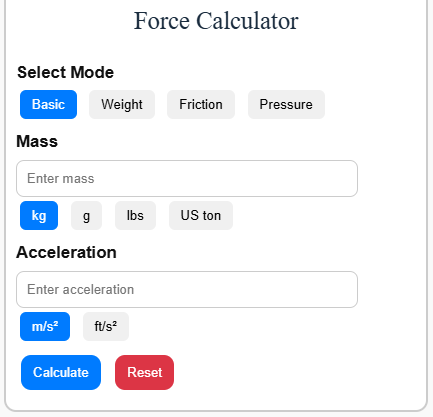
Forces are all around us—whether it’s a car accelerating, an object falling due to gravity, or friction slowing things down. Understanding how force works helps explain motion, balance, and everyday physical interactions. This force calculator combines multiple methods for calculating force, allowing you to explore how various factors, such as mass, acceleration, pressure, and surface contact, impact the outcome.
Instead of memorizing formulas, it allows you to see how changing inputs directly influences force values. It’s especially useful for students, engineers, and anyone learning physics concepts practically.
By switching between modes, you can better understand how the same concept applies differently in real-world situations.
How to Calculate Force
Force can be calculated in different ways depending on the situation. In physics, it explains how objects move, stop, or change direction. Below are the main methods used to calculate force, along with formulas and practical examples.
1. Basic Force (Mass × Acceleration)
Formula: F = m × a
- F = Force (Newton, N)
- m = Mass (kg)
- a = Acceleration (m/s²)
Example:
A body has a mass of 5 kg and accelerates at 3 m/s².
F = 5 × 3 = 15 N
2. Gravitational Force (Weight)
Formula: F = m × g
- g = Gravity (9.8 m/s² on Earth)
Example:
A person has a mass of 60 kg.
F = 60 × 9.8 = 588 N
3. Frictional Force
Formula: F = μ × N
- μ = Coefficient of friction
- N = Normal force (N)
Example:
If μ = 0.4 and N = 200 N:
F = 0.4 × 200 = 80 N
4. Force from Pressure
Formula: F = P × A
- P = Pressure (Pascal, Pa)
- A = Area (m²)
Example:
Pressure is 5000 Pa acting on an area of 2 m².
F = 5000 × 2 = 10000 N
Each method of calculating force depends on the physical situation. Whether it’s motion, gravity, surface contact, or pressure, understanding these formulas helps you solve real-world problems more accurately.
Sample Force Values Table
| Method | Input Values | Formula | Result |
|---|---|---|---|
| Basic Force | m = 2 kg, a = 4 m/s² | F = 2 × 4 | 8 N |
| Basic Force | m = 10 kg, a = 1.5 m/s² | F = 10 × 1.5 | 15 N |
| Weight | m = 5 kg, g = 9.8 m/s² | F = 5 × 9.8 | 49 N |
| Weight | m = 70 kg, g = 9.8 m/s² | F = 70 × 9.8 | 686 N |
| Friction | μ = 0.2, N = 150 N | F = 0.2 × 150 | 30 N |
| Friction | μ = 0.6, N = 300 N | F = 0.6 × 300 | 180 N |
| Pressure Force | P = 2000 Pa, A = 1.5 m² | F = 2000 × 1.5 | 3000 N |
| Pressure Force | P = 5000 Pa, A = 0.8 m² | F = 5000 × 0.8 | 4000 N |
FAQs
1. What is the most common formula to calculate force?
The most commonly used formula is F = m × a, where force is calculated by multiplying mass with acceleration. It is used in motion-related problems.
2. Why are there different formulas for force?
Force depends on the situation. For example, gravity uses F = m × g, friction uses F = μ × N, and pressure uses F = P × A. Each formula applies to a specific physical condition.
3. Can force be measured in units other than Newtons?
Yes, force can also be expressed in kilonewtons (kN) and pound-force (lbf). However, Newton (N) is the standard SI unit used in most scientific calculations.
Related Calculators:
References: