👤 By whycalculator Team 📅 Last Updated March 10, 2026
Sales Ratio Calculator
Disclaimer: While we strive to ensure the accuracy of our calculator tools, we cannot be held responsible for any damages or financial losses resulting from their use.
Sales ratios are widely used in business and retail to understand how various sales figures relate to one another. By analyzing these ratios, businesses can quickly see which products, categories, or channels contribute the most to overall revenue. This Sales Ratio Calculator helps you measure sales contribution, compare performance against targets, and evaluate the relationship between two sales values.
Whether you are tracking product contribution or measuring progress toward a sales goal, this tool provides a quick and simple solution.
How to Calculate Sales Ratio
To calculate a sales ratio, first identify the two specific sales figures you want to compare, such as a product’s sales versus total sales or actual sales versus sales targets. Next, determine the order of comparison by deciding which figure will serve as the numerator and which will serve as the denominator.
Finally, divide the numerator by the denominator and multiply the result by 100 to convert it into a percentage.
Formula: Sales Ratio = (Specific Sales Figure / Base Sales Figure) × 100
1. Sales Contribution Ratio
This method shows how much a specific product or category contributes to the total sales.
Formula:
Sales Contribution Ratio = (Product or Category Sales ÷ Total Sales) × 100
Example:
If a store earns $2,000 from Product A and the total store sales are $10,000:
Sales Contribution Ratio = (2000 ÷ 10000) × 100 = 20%
This means Product A contributes 20% of the total sales.
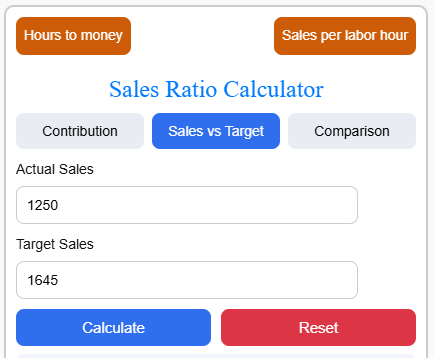
2. Sales vs Target Ratio
This ratio measures how much of the sales goal has been achieved.
Formula:
Sales Achievement Ratio = (Actual Sales ÷ Target Sales) × 100
Example:
If the monthly target is $12,000 and the business achieves $9,000 in sales:
Sales Achievement Ratio = (9000 ÷ 12000) × 100 = 75%
This means the business has achieved 75% of its sales target.
3. Sales Comparison Ratio
Sometimes businesses compare two sales values directly to understand which performs better.
Formula:
Sales Ratio = Sales A : Sales B
Example:
If online sales are $6,000 and in-store sales are $4,000:
Sales Ratio = 6000 : 4000 = 3 : 2
This means online sales are 1.5 times higher than in-store sales.
Using these methods helps businesses evaluate performance, track progress toward sales targets, and understand how different products or channels contribute to overall revenue.
Sales Ratio Sample Values
| Product Sales | Total Sales | Contribution Ratio | Actual Sales | Target Sales | Target Achievement |
|---|---|---|---|---|---|
| 500 | 2000 | 25% | 1500 | 2000 | 75% |
| 800 | 4000 | 20% | 3200 | 4000 | 80% |
| 1200 | 6000 | 20% | 4500 | 6000 | 75% |
| 1500 | 5000 | 30% | 4200 | 5000 | 84% |
| 2000 | 10000 | 20% | 9000 | 10000 | 90% |
| 2500 | 12500 | 20% | 10000 | 12000 | 83.33% |
| 3000 | 15000 | 20% | 12000 | 15000 | 80% |
| 3500 | 17500 | 20% | 14000 | 17500 | 80% |
| 4000 | 20000 | 20% | 16000 | 20000 | 80% |
| 4500 | 22500 | 20% | 18000 | 22500 | 80% |
Related Calculators: