👤 By whycalculator Team 📅 Last Updated March 09, 2026
Sales per Labor Hour
Disclaimer: While we strive to ensure the accuracy of our calculator tools, we cannot be held responsible for any damages or financial losses resulting from their use.
Sales per Labour Hour (SPLH) tells you how much revenue your business generates for each hour employees work. Companies often use this metric to evaluate productivity, manage labor costs, and improve staffing decisions. Comparing sales to total labor hours helps businesses determine whether their workers are effective or if adjustments are needed.
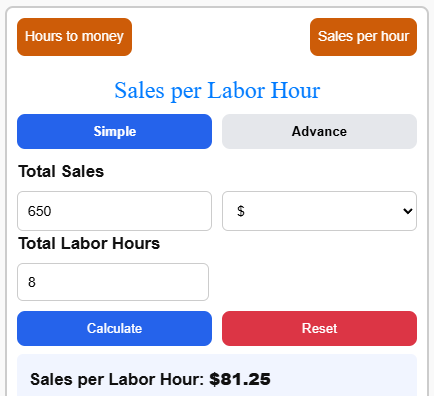
This calculator allows you to estimate sales per labor hour using simple inputs like total sales and labor hours. In advanced mode, it also looks at labor costs and potential profits.
How to Calculate Sales per Labour Hour (SPLH)
Calculate Sales per Labour Hour (SPLH) by dividing your total net sales by the total number of labor hours worked during the same period.
SPLH = Total Net Sales ÷ Total Labor Hours
For example, if your store generates $5,000 in sales and your employees work a combined total of 100 hours, your SPLH is $50. This means your business produces $50 in revenue for every hour of labor worked.
Basic SPLH Formula
The basic formula for calculating Sales per Labour Hour is:
This means you divide the total revenue generated during a specific period by the total number of labor hours worked by employees in that same period.
Example 1 – Simple Calculation
Suppose a retail store records the following numbers for a day:
- Total Sales: $2,000
- Total Labour Hours: 80 hours
Using the formula:
This means the business generates $25 in sales for every labour hour worked.
Example 2 – Weekly Business Example
- Total Weekly Sales: $15,500
- Total Labour Hours: 620 hours
In this case, each hour of employee work contributes about $25 in revenue for the business.
Advanced Analysis (With Labour Cost)
In advanced mode, the calculator also considers the average hourly labour salary and the number of labourers. This helps estimate labour costs and determine whether the company is generating profit or loss from labour.
Example 3 – Advanced Mode Calculation
- Total Sales: $5,000
- Total Labour Hours: 200 hours
- Average Labour Salary: $12 per hour
- Number of Labourers: 5
Step 1: Calculate Sales per Labour Hour
SPLH = 5000 ÷ 200 = $25
This means the business generates $25 in sales for every labour hour worked.
Step 2: Calculate Total Labour Cost
Total Labour Cost = 12 × 200 = $2,400
Step 3: Calculate Profit Before Other Expenses
Profit = 5000 − 2400 = $2,600
Since the sales generated per labour hour ($25) are higher than the hourly labour cost ($12), the company is generating a positive margin from labour. After paying employees, the business keeps about $2,600 before other expenses such as rent, utilities, or materials.
The calculator also shows the average hours per labourer:
200 ÷ 5 = 40 hours
If the sales generated per hour are significantly higher than the labour cost, the business is operating efficiently. If labour costs exceed revenue generated per hour, it may indicate overstaffing or low sales productivity.
Why SPLH Matters
- Measures employee productivity
- Helps optimize staff scheduling
- Controls labour costs
- Improves operational efficiency
- Supports better business decision making
Simple Mode Examples
| Total Sales ($) | Total Labour Hours | Sales per Labour Hour ($) |
|---|---|---|
| 500 | 20 | 25 |
| 800 | 40 | 20 |
| 1,200 | 50 | 24 |
| 1,500 | 60 | 25 |
| 2,000 | 80 | 25 |
| 2,500 | 100 | 25 |
| 3,200 | 120 | 26.67 |
| 4,000 | 150 | 26.67 |
| 4,800 | 180 | 26.67 |
| 5,000 | 200 | 25 |
Related Calculators: