👤 📅 Last Updated April 20, 2026
Initial Velocity Calculator
Disclaimer: While we strive to ensure the accuracy of our calculator tools, we cannot be held responsible for any damages or financial losses resulting from their use.
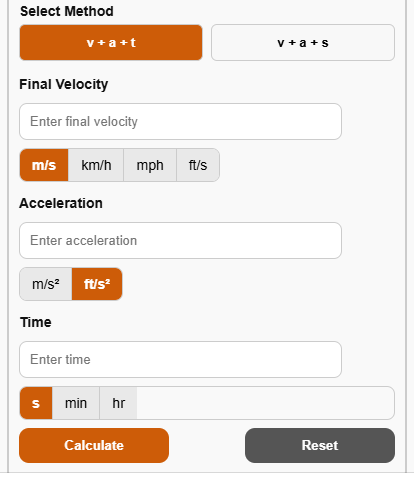
The starting speed of an object is important in physics and motion problems, whether you’re analyzing a moving vehicle, projectile, or falling object. This Initial Velocity Calculator helps you quickly determine the initial velocity using common motion formulas. Instead of solving equations manually, you can enter known values like final velocity, acceleration, time, or distance to get accurate results instantly.
Use it to verify homework answers, test scenarios, or better understand how motion variables relate to each other.
How to Calculate Initial Velocity
To calculate initial velocity, start by identifying the known values such as final velocity, acceleration, time, or displacement. Then choose the appropriate equation of motion that connects those values. Rearrange the equation and substitute the known values to find the result.
Initial Velocity Formulas
Formula 1: Using Final Velocity, Acceleration, and Time
If you know the final velocity, acceleration, and time, the initial velocity can be calculated using:
u = v − at
- u = Initial velocity
- v = Final velocity
- a = Acceleration
- t = Time
Example 1
A car reaches a final velocity of 25 m/s after accelerating at 3 m/s² for 5 seconds.
u = v − at
u = 25 − (3 × 5)
u = 25 − 15
u = 10 m/s
So, the initial velocity of the car was 10 m/s.
Formula 2: Using Final Velocity, Acceleration, and Distance
If time is not known but distance is given, use this formula:
u = √(v² − 2as)
- s = Displacement (distance traveled)
Example 2
An object has a final velocity of 30 m/s, acceleration of 2 m/s², and displacement of 100 meters.
u = √(v² − 2as)
u = √(30² − 2 × 2 × 100)
u = √(900 − 400)
u = √500
u ≈ 22.36 m/s
This means the object started moving at approximately 22.36 m/s.
Formula 3: Using Displacement, Acceleration, and Time
When displacement, time, and acceleration are known, use:
u = (s − ½at²) ÷ t
Example 3
An object travels 80 meters in 4 seconds with an acceleration of 2 m/s².
u = (s − ½at²) ÷ t
u = (80 − ½ × 2 × 4²) ÷ 4
u = (80 − 16) ÷ 4
u = 64 ÷ 4
u = 16 m/s
Therefore, the initial velocity of the object was 16 m/s.
Initial Velocity Calculation Examples
| Final Velocity (v) | Acceleration (a) | Time (t) | Distance (s) | Initial Velocity (u) |
|---|---|---|---|---|
| 20 m/s | 2 m/s² | 5 s | — | 10 m/s |
| 25 m/s | 3 m/s² | 4 s | — | 13 m/s |
| 30 m/s | 2 m/s² | — | 100 m | 22.36 m/s |
| 18 m/s | 1.5 m/s² | 6 s | — | 9 m/s |
| 35 m/s | 2.5 m/s² | — | 150 m | 25 m/s |
| 22 m/s | 1 m/s² | 8 s | — | 14 m/s |
| 28 m/s | 2 m/s² | — | 120 m | 20 m/s |
| 16 m/s | 1.2 m/s² | 5 s | — | 10 m/s |
| 40 m/s | 3 m/s² | — | 200 m | 28.28 m/s |
| 24 m/s | 2 m/s² | 6 s | — | 12 m/s |
| 32 m/s | 2.5 m/s² | — | 180 m | 22.45 m/s |
| 26 m/s | 1.8 m/s² | 7 s | — | 13.4 m/s |
Frequently Asked Questions
Why can initial velocity be negative?
Initial velocity can be negative when an object moves in the opposite direction of the chosen positive direction. In physics, direction matters, so negative values simply represent motion in the reverse direction.
What happens if acceleration is zero when calculating initial velocity?
If acceleration is zero, the object’s velocity remains constant. In this case, the initial velocity and final velocity are equal because there is no change in speed over time.
Related Calculators: