👤 📅 Last Updated April 20, 2026
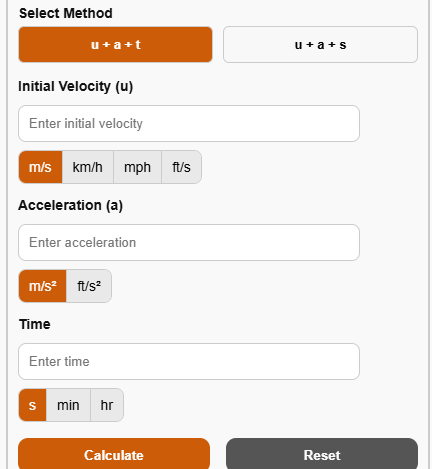
Final Velocity Calculator
Disclaimer: While we strive to ensure the accuracy of our calculator tools, we cannot be held responsible for any damages or financial losses resulting from their use.
Final velocity describes how fast an object is moving at the end of its motion after acceleration has acted on it for a period of time or distance. It is an important concept in physics and engineering because it helps determine how speed changes under different conditions. By using known values such as initial velocity, acceleration, time, or distance, final velocity can be calculated using standard equations of motion.
Understanding final velocity makes it easier to analyze moving objects like vehicles, projectiles, and mechanical systems. That’s why we design this Final Velocity Calculator to help apply these motion formulas accurately, making it easier to study motion behavior and verify physics calculations in practical situations.
How to Calculate Final Velocity
To calculate final velocity, use the kinematic equation that matches your known variables:
- If you know initial velocity, acceleration, and time:
v = u + at - If you know initial velocity, acceleration, and distance:
v² = u² + 2as - If you know initial velocity, displacement, and time:
v = (2s / t) - u
Variables:
- v: Final Velocity
- u: Initial Velocity
- a: Acceleration
- t: Time
- s: Displacement
Final Velocity Formulas:
Formula 1: Using Initial Velocity, Acceleration, and Time
When initial velocity, acceleration, and time are known, use this formula:
v = u + at
- v = Final velocity
- u = Initial velocity
- a = Acceleration
- t = Time
Example 1
A vehicle starts with an initial velocity of 12 m/s and accelerates at 3 m/s² for 5 seconds.
v = u + at
v = 12 + (3 × 5)
v = 12 + 15
v = 27 m/s
So, the final velocity of the vehicle is 27 m/s.
Formula 2: Using Initial Velocity, Acceleration, and Distance
If time is not given but distance is known, use this formula:
v = √(u² + 2as)
- s = Displacement (distance traveled)
Example 2
An object has an initial velocity of 10 m/s, acceleration of 2 m/s², and travels 50 meters.
v = √(u² + 2as)
v = √(10² + 2 × 2 × 50)
v = √(100 + 200)
v = √300
v ≈ 17.32 m/s
This means the object reaches a final velocity of approximately 17.32 m/s.
Formula 3: Using Average Velocity and Time
In some cases, final velocity can also be calculated using average velocity when motion is uniformly accelerated:
v = 2 × (Average Velocity) − u
Example 3
An object has an average velocity of 15 m/s and an initial velocity of 8 m/s.
v = 2 × Average Velocity − u
v = 2 × 15 − 8
v = 30 − 8
v = 22 m/s
Therefore, the final velocity of the object is 22 m/s.
Final Velocity Calculation Examples
| Initial Velocity (u) | Acceleration (a) | Time (t) | Distance (s) | Final Velocity (v) |
|---|---|---|---|---|
| 10 m/s | 2 m/s² | 5 s | — | 20 m/s |
| 12 m/s | 3 m/s² | 4 s | — | 24 m/s |
| 8 m/s | 1.5 m/s² | 6 s | — | 17 m/s |
| 15 m/s | 2 m/s² | 7 s | — | 29 m/s |
| 10 m/s | 2 m/s² | — | 50 m | 17.32 m/s |
| 6 m/s | 1 m/s² | — | 40 m | 10.95 m/s |
| 14 m/s | 2.5 m/s² | — | 60 m | 22.36 m/s |
| 9 m/s | 1.8 m/s² | 5 s | — | 18 m/s |
| 11 m/s | 2.2 m/s² | 3 s | — | 17.6 m/s |
| 7 m/s | 1.2 m/s² | — | 30 m | 10.95 m/s |
| 13 m/s | 2 m/s² | 6 s | — | 25 m/s |
| 5 m/s | 1 m/s² | — | 20 m | 8.94 m/s |
Frequently Asked Questions
Can final velocity be zero?
Yes, final velocity can be zero when an object comes to a complete stop. This usually happens when acceleration acts in the opposite direction of motion and reduces the object’s speed to zero.
Is final velocity always greater than initial velocity?
No, final velocity is not always greater than initial velocity. If an object slows down due to negative acceleration or resistance, the final velocity can be smaller than the initial velocity.
Related Calculators: