👤 By whycalculator Team 📅 Last Updated March 30, 2026
Resultant Force Calculator
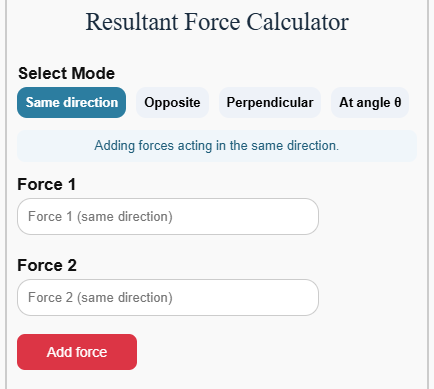
Adding forces acting in the same direction.
Result preview
Press “CALCULATE” to see detailed table of resultant force
Press “CALCULATE” to see detailed table of resultant force
Disclaimer: While we strive to ensure the accuracy of our calculator tools, we cannot be held responsible for any damages or financial losses resulting from their use.
Forces rarely act alone in the real world—whether it’s pushing a box, lifting a load, or analyzing structures, multiple forces usually combine and influence motion together. A resultant force represents the single force that can replace all those individual forces while producing the same effect.
Understanding how to calculate it helps in visualizing direction, balance, and motion in a much more precise way. This resultant force calculator makes it easier to understand how forces work together in different situations. You can see how they interact when they act in the same direction, opposite directions, or at angles.
How to Calculate Resultant Force
In physics, multiple forces can act on an object at the same time. Instead of analyzing each force separately, we combine them into a single equivalent force called the resultant force. This helps us understand how an object will move or remain in balance.
The method used to calculate the resultant force depends on the direction and angle between the forces. Below are the most common methods explained with formulas and examples.
1. Forces in the Same Direction
When all forces act in the same direction, simply add them together.
Formula: F = F₁ + F₂ + F₃ + …
Example:
A force of 10 N and another of 5 N act in the same direction.
F = 10 + 5 = 15 N
2. Forces in Opposite Directions
When forces act in opposite directions, subtract the smaller force from the larger one.
Formula: F = F₁ − F₂
Example:
A force of 12 N acts to the right and 7 N acts to the left.
F = 12 − 7 = 5 N (to the right)
3. Perpendicular Forces (90°)
When forces act at right angles, use the Pythagorean theorem to find the resultant.
Formula: F = √(F₁² + F₂²)
Example:
A horizontal force of 6 N and a vertical force of 8 N act on an object.
F = √(6² + 8²) = √(36 + 64) = √100 = 10 N
4. Forces at Any Angle
When forces act at an angle other than 90°, use the cosine formula.
Formula: F = √(F₁² + F₂² + 2F₁F₂ cosθ)
Example:
Two forces of 10 N and 8 N act at an angle of 60°.
F = √(10² + 8² + 2 × 10 × 8 × cos60°)
F = √(100 + 64 + 160 × 0.5)
F = √(100 + 64 + 80) = √244 ≈ 15.62 N
5. Using Components (Most Practical Method)
Forces can also be broken into horizontal (Fx) and vertical (Fy) components. This method is widely used in engineering and physics.
Steps:
- Resolve each force into horizontal (Fx) and vertical (Fy)
- Add all horizontal components
- Add all vertical components
- Use the formula below
Formula: F = √(Fx² + Fy²)
Example:
Fx = 6 N and Fy = 8 N
F = √(6² + 8²) = √100 = 10 N
By understanding these methods, you can easily calculate the resultant force in any situation, whether forces are aligned, opposite, or acting at different angles.
FAQs
1. Why is resultant force important in real-life applications?
Resultant force helps us understand how multiple forces affect motion in real situations such as vehicles moving, objects being lifted, or structures تحمل loads. Engineers and designers use it to ensure stability, safety, and proper functioning of machines and buildings.
2. Can the resultant force ever be zero?
Yes, when all forces acting on an object balance each other perfectly, the resultant force becomes zero. This condition is called equilibrium, where the object either remains at rest or continues moving at a constant speed without changing direction.
Related Calculators:
References: