👤 By whycalculator Team 📅 Last Updated March 24, 2026
Shaft Torque Calculator
Disclaimer: While we strive to ensure the accuracy of our calculator tools, we cannot be held responsible for any damages or financial losses resulting from their use.
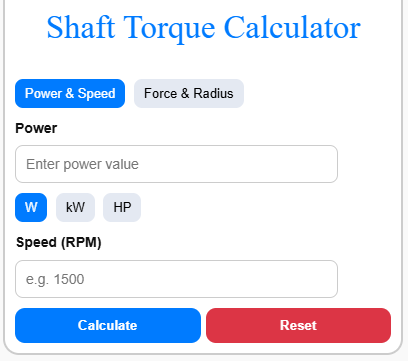
This Shaft Torque Calculator is designed to make complex mechanical calculations simple and accessible for anyone working with rotating systems. It’s especially useful when you’re dealing with motors, shafts, or any rotating system and need a fast answer. This tool supports both power-based and force-based inputs. So you can use it in different real-world situations.
Whether you’re a student or working in the field, it saves time and makes calculations much easier. Overall, it’s a reliable companion for quick and efficient torque estimation.
How to Calculate Shaft Torque
Shaft torque is the rotational force transmitted by a shaft. It is commonly calculated using either power and speed or force and radius, depending on the available data.
1. Using Power and Speed
This is the most common method, especially for motors and rotating machines.
Formula:
T = (9550 × P) / N
- T = Torque (Nm)
- P = Power (kW)
- N = Speed (RPM)
Example 1:
If a motor delivers 5 kW power at 1000 RPM:
T = (9550 × 5) / 1000 = 47.75 Nm
So, the shaft torque is 47.75 Nm.
2. Using Force and Radius
If a force is applied at a distance from the center of rotation, torque can be calculated directly.
Formula:
T = F × r
- F = Force (Newton)
- r = Radius (meter)
Example 2:
If a force of 100 N is applied at a radius of 0.2 m:
T = 100 × 0.2 = 20 Nm
So, the torque produced is 20 Nm.
Example 3: Power & Speed Mode (Watts)
- Mode: Power
- Power: 5000 W
- Speed: 1500 RPM
Calculation:
- Convert power → 5000 W = 5 kW
- Torque = (9550 × 5) / 1500 = 31.83 Nm
Result:
- 31.83 Nm
- 23.48 lb-ft
- 3.25 kgf·m
Example 4: Power & Speed Mode (Horsepower)
- Mode: Power
- Power: 10 hp
- Speed: 2000 RPM
Calculation:
- Convert power → 10 hp = 7.457 kW
- Torque = (9550 × 7.457) / 2000 = 35.60 Nm
Result:
- 35.60 Nm
- 26.26 lb-ft
- 3.63 kgf·m
Example 5: Force & Radius Mode
- Mode: Force
- Force: 100 N
- Radius: 50 cm
Calculation:
- Convert radius → 50 cm = 0.5 m
- Torque = 100 × 0.5 = 50.00 Nm
Result:
- 50.00 Nm
- 36.88 lb-ft
- 5.10 kgf·m
Sample Shaft Torque Values
| Power (kW) | Speed (RPM) | Force (N) | Radius (m) | Torque (Nm) |
|---|---|---|---|---|
| 1 | 1000 | – | – | 9.55 |
| 2 | 1500 | – | – | 12.73 |
| 3 | 1200 | – | – | 23.88 |
| 5 | 1000 | – | – | 47.75 |
| 4 | 800 | – | – | 47.75 |
| – | – | 50 | 0.1 | 5 |
| – | – | 100 | 0.2 | 20 |
| – | – | 200 | 0.15 | 30 |
| 1.5 | 1200 | – | – | 11.94 |
| 2.5 | 900 | – | – | 26.53 |
| – | – | 75 | 0.3 | 22.5 |
| 3 | 1500 | – | – | 19.1 |
| 4 | 1200 | – | – | 31.83 |
| – | – | 150 | 0.25 | 37.5 |
| 5 | 2000 | – | – | 23.88 |
Key Points
- Higher power or lower speed results in higher torque.
- Increasing radius increases torque linearly.
- Always use consistent units (kW, RPM, meters, Newton).
Related Calculators:
Reference: