👤 By whycalculator Team 📅 Last Updated April 04, 2026
Pipe Slope Calculator
Disclaimer: While we strive to ensure the accuracy of our calculator tools, we cannot be held responsible for any damages or financial losses resulting from their use.
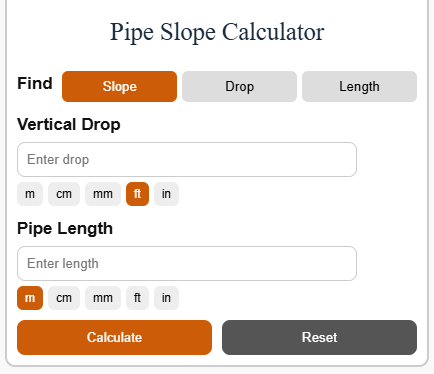
This Pipe Slope Calculator helps you quickly determine the correct slope, drop, or length required for proper pipe installation. It’s especially useful for drainage, sewerage, and plumbing systems where an accurate slope is critical for smooth flow. Instead of manual calculations, it simplifies the process using practical engineering formulas.
Whether you’re working on plumbing, construction, or site drainage, it gives accurate results in seconds. With multiple calculation modes and unit, it makes real-world pipe slope layout planning much easier.
How to Calculate Pipe Slope
Pipe slope is the rate at which a pipe declines over a certain distance. Pipe slope is calculated by dividing the vertical drop (fall) by the horizontal length of the pipe.
Pipe Slope = Vertical Drop ÷ Horizontal Distance
For example, if a pipe drops 1 meter over a length of 50 meters, the slope is 1:50 or 2%. A decent slope ensures efficient flow and helps prevent drainage issues like blockages or backflow.1. Calculate Slope (Using Drop and Length)
Formula:
Slope (%) = (Vertical Drop ÷ Pipe Length) × 100
Example:
A drainage pipe runs 12 meters from a house to a sewer line. The total vertical drop is 0.18 meters (18 cm).
Calculation:
Slope = (0.18 ÷ 12) × 100 = 1.5%
This means the pipe drops 1.5 meters for every 100 meters of length, which is suitable for typical wastewater drainage.
2. Calculate Required Drop (Using Slope and Length)
Formula:
Drop = (Slope ÷ 100) × Length
Example:
You are installing a 6-meter kitchen drain pipe and want a standard slope of 2% for proper flow.
Calculation:
Drop = (2 ÷ 100) × 6 = 0.12 meters = 12 cm
So, the pipe should drop 12 cm from the start point to the endpoint to maintain proper drainage.
3. Calculate Pipe Length (Using Drop and Slope)
Formula:
Length = Drop ÷ (Slope ÷ 100)
Example:
A site has a vertical drop of 0.3 meters available, and the required slope is 1%.
Calculation:
Length = 0.3 ÷ (1 ÷ 100) = 30 meters
This means the pipe can extend up to 30 meters while maintaining a 1% slope.
Practical Notes
- 1% slope = 1 cm drop per 1 meter length
- 2% slope = 2 cm drop per 1 meter length
- Too steep slope may cause water to flow faster than solids
- Too flat slope may lead to clogging
| Pipe Length (m) | Slope (%) | Drop (cm) |
|---|---|---|
| 10 | 1% | 10 |
| 12 | 1.5% | 18 |
| 15 | 1% | 15 |
| 18 | 2% | 36 |
| 20 | 1% | 20 |
| 25 | 0.8% | 20 |
| 30 | 1% | 30 |
| 35 | 1.5% | 52.5 |
| 40 | 0.5% | 20 |
| 45 | 1% | 45 |
| 50 | 2% | 100 |
| 60 | 1% | 60 |
FAQs
1. What is the recommended slope for drainage pipes?
For most drainage systems, a slope between 1% and 2% is recommended. This means a drop of 1–2 cm per meter (10–20 mm/m). It ensures smooth flow without causing blockages or fast speed.
2. What happens if pipe slope is too steep or too flat?
If the slope is too steep, water flows too quickly and leaves solids behind, causing clogs. If it is too flat, flow becomes slow and can lead to sediment buildup and blockage over time.
Related Calculators:
References:
https://plumbernw.com/how-to-calculate-drain-pipe-slope