👤 By whycalculator Team 📅 Last Updated April 09, 2026
Gauge to mm Calculator
| Measurement | Value |
|---|---|
| No data available | |
Disclaimer: While we strive to ensure the accuracy of our calculator tools, we cannot be held responsible for any damages or financial losses resulting from their use.
Are you trying to find the exact thickness in millimeters for a specific gauge? Our Gauge to mm Calculator makes it simple to effortlessly convert gauge values into millimeters. Select material type & gauge number and get accurate results in seconds!
How to Convert Gauge to mm?
Converting gauge to millimeters (mm) depends on the material, as gauge values vary across industries. Here’s a step-by-step process:
Steps to Convert Gauge to mm
- Identify the Material: Determine whether the gauge value refers to sheet metal, wire, or another material. Different standards apply for each material type (e.g., American Wire Gauge for wires, Standard Gauge for metals).
- Table of Formula:
- Most materials have predefined tables that link gauge numbers to mm values.
- For wires, American Wire Gauge (AWG) often applies.
- For sheet metals, Standard Sheet Metal Gauge Table are used.
Example 1: Sheet Metal Conversion
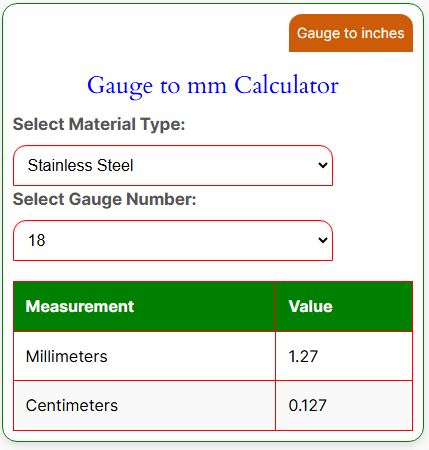
Material: Stainless steel
Gauge Value: 18
From the Standard Sheet Metal Gauge Table,
18 gauge = 1.270 mm (approximately).
Thus, 18 gauge stainless steel is 1.270 mm thick.
Example 2: Wire Conversion (Using AWG)
Gauge Value: 12
AWG provides specific diameters for wires. For a 12-gauge wire,
Diameter = 2.05 mm (approximately).
What Is Gauge to mm?
Gauge to mm is the process of converting a gauge measurement into millimeters (mm). A millimeter is a standard metric unit of length. Gauge is commonly used in industries such as metalworking, wire manufacturing, and sheet metal production to indicate thickness or diameter.
However, the relationship between gauges and millimeters is not linear and depends on the type of material.
References:
FAQs:
How do gauge numbers relate to millimeters?
Gauge numbers are inversely proportional to thickness or diameter. This means that as the gauge number increases, the material thickness decreases.
Why do different materials have different gauge-to-mm conversions?
Gauge measurements are based on specific standards that depend on the material’s properties.
Can I use this calculator for all materials?
Yes, but you need to select the appropriate material type (e.g., stainless steel, copper, wire) as each material has a different thickness.