👤 By whycalculator Team 📅 Last Updated March 28, 2026
Frost Point Calculator
Disclaimer: While we strive to ensure the accuracy of our calculator tools, we cannot be held responsible for any damages or financial losses resulting from their use.
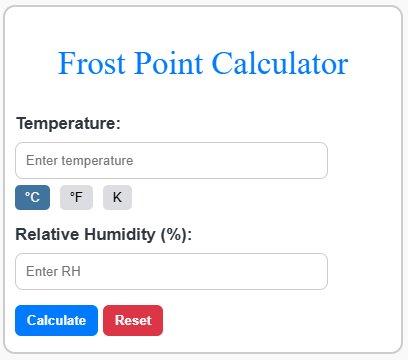
This Frost Point Calculator is for understanding how temperature and humidity interact to create frost or dew. Instead of relying on brainiac calculation, this tool quickly tells you the temperature at which moisture in the air will condense, and whether it will form ice crystals or dew. It’s useful for gardeners, weather enthusiasts, and HVAC professionals who need to predict frost conditions accurately.
By entering current air temperature and relative humidity, you’ll get precise results in multiple units—Celsius, Fahrenheit, and Kelvin.
Beyond just numbers, it gives the real-world implications of your weather conditions, helping you take the right precautions or make informed decisions.
How to Calculate Frost Point
The frost point is the temperature at which water vapor in the air changes directly into ice instead of liquid water. It depends mainly on the current air temperature and the relative humidity. To calculate it, we first convert the given temperature into Celsius (if needed), then use the frost point formula.
Frost Point Formula
The commonly used formula is:
γ = ln(RH / 100) + (a × T) / (b + T)
Frost Point (°C) = (b × γ) / (a – γ)
Where:
- T = air temperature in °C
- RH = relative humidity in %
- a = 17.27
- b = 237.7
- ln = natural logarithm
Step-by-Step Example
Let’s say the air temperature is -5°C and the relative humidity is 70%.
Step 1: Calculate γ
γ = ln(70 / 100) + (17.27 × -5) / (237.7 + -5)
γ = ln(0.70) + (-86.35 / 232.7)
γ = -0.3567 – 0.3710 = -0.7277
Step 2: Apply Frost Point Formula
Frost Point = (237.7 × -0.7277) / (17.27 – (-0.7277))
Frost Point = -172.98 / 17.9977
Frost Point = -9.61°C
Result Interpretation
The frost point is -9.61°C, which means frost can start forming if the surrounding surface temperature drops to this value. If the result is above 0°C, it is technically a dew point rather than a true frost point because moisture will form as liquid water first.
Real-World Example 1: Car Windshield Frost
Suppose the outside air temperature is -2°C and the relative humidity is 90%. This is a common winter morning situation when checking whether frost may appear on your car windshield.
Step 1: Calculate γ
γ = ln(90 / 100) + (17.27 × -2) / (237.7 + -2)
γ = ln(0.90) + (-34.54 / 235.7)
γ = -0.1053 – 0.1466 = -0.2519
Step 2: Calculate Frost Point
Frost Point = (237.7 × -0.2519) / (17.27 – (-0.2519))
Frost Point = -59.89 / 17.5219
Frost Point = -3.42°C
This means if your windshield surface cools to -3.42°C or below overnight, frost will likely form.
Real-World Example 2: Garden Plant Protection
Imagine the nighttime air temperature is 1°C and the relative humidity is 95%. Gardeners often use frost point to know whether sensitive plants need covering.
Step 1: Calculate γ
γ = ln(95 / 100) + (17.27 × 1) / (237.7 + 1)
γ = ln(0.95) + (17.27 / 238.7)
γ = -0.0513 + 0.0723 = 0.0210
Step 2: Calculate Frost Point
Frost Point = (237.7 × 0.0210) / (17.27 – 0.0210)
Frost Point = 4.99 / 17.249
Frost Point = 0.29°C
Because the result is above freezing, this is technically closer to a dew point than a true frost point. Moisture will first appear as dew unless the plant surface itself drops below 0°C.
Quick Tip
A lower humidity value always pushes the frost point further below the air temperature, while higher humidity brings it closer to the current temperature.
Frost Point Sample Values Table
The table below shows sample frost point values for different combinations of air temperature and relative humidity. These examples help you quickly understand how changing humidity levels affect the frost point.
| Air Temp (°C) | Relative Humidity (%) | Frost / Dew Point (°C) |
|---|---|---|
| -10 | 40 | -20.22 |
| -8 | 55 | -15.32 |
| -5 | 70 | -9.61 |
| -3 | 80 | -6.03 |
| -2 | 90 | -3.42 |
| 0 | 60 | -6.84 |
| 1 | 95 | 0.29 |
| 3 | 85 | 0.66 |
| 5 | 75 | 0.99 |
| 8 | 65 | 1.79 |
| 10 | 80 | 6.71 |
| 12 | 85 | 9.43 |
Frequently Asked Questions
Does a higher humidity level make frost more likely?
Yes, higher relative humidity usually brings the frost point closer to the current air temperature. This means the air needs less cooling before moisture begins to freeze on surfaces, increasing the chance of frost during cold nights.
Why do cars and grass get frost before the air reaches freezing?
Objects exposed to the open sky lose heat faster than the surrounding air through radiation. Because of this, surfaces like car windshields, rooftops, and grass can fall below 0°C first, allowing frost to form even when the official air temperature is still a little higher.
Can this calculator still be used when the result is above 0°C?
Absolutely. When the calculated value is above freezing, the result helps you identify the dew point instead of a true frost point. This is still useful for understanding when windows, pipes, or outdoor surfaces may develop condensation.
Related Calculators: