👤 By whycalculator Team 📅 Last Updated March 11, 2026
Torque to Weight Ratio
Disclaimer: While we strive to ensure the accuracy of our calculator tools, we cannot be held responsible for any damages or financial losses resulting from their use.
Understanding how much rotational force a machine produces relative to its weight can reveal a lot about its real performance. This Torque-to-Weight Ratio Calculator helps you quickly measure this relationship by comparing torque output with total weight. It’s useful for evaluating engines, vehicles, motors, and other mechanical systems where pulling power and efficiency matter.
Whether you’re analyzing performance or just curious about mechanical efficiency, this calculator provides a quick and clear answer.
How to Calculate Torque-to-Weight Ratio
The torque-to-weight ratio is calculated by dividing the rotational force (torque) by the total weight of the vehicle, motor, or machine. This measurement helps evaluate performance efficiency, as a higher ratio typically indicates stronger acceleration and pulling power relative to the object’s mass.
Torque to Weight Ratio Formula
The formula used to calculate the torque-to-weight ratio is:
Torque-to-Weight Ratio = Torque ÷ Weight
- Torque is the rotational force produced by an engine or motor (usually in Nm or ft-lb).
- Weight is the total mass of the object or vehicle (usually in kg or lb).
The result is typically expressed as Nm/kg or ft-lb/lb, depending on the units used.
Calculation
- Determine the torque output of the machine or engine.
- Find the total weight of the system.
- Divide the torque value by the weight.
- The result represents the torque produced per unit of weight.
Examples from Daily Life
1. Car Engine Performance
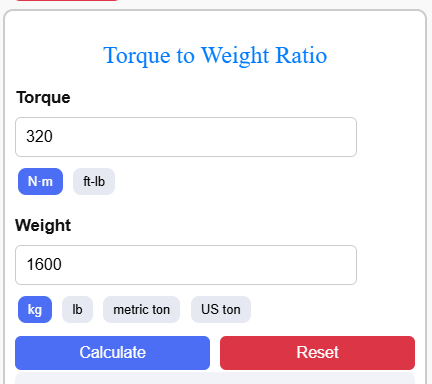
A car engine produces 320 Nm of torque and the car weighs 1600 kg.
= 320 ÷ 1600 = 0.20 Nm/kg
This means the car produces 0.20 Nm of torque for every kilogram of weight.
2. Motorcycle Power Comparison
A motorcycle produces 120 Nm of torque and weighs 240 kg.
= 120 ÷ 240 = 0.50 Nm/kg
Motorcycles often have higher ratios than cars, which helps them accelerate quickly.
3. Electric Scooter
An electric scooter motor generates 35 Nm of torque and the scooter weighs 70 kg.
= 35 ÷ 70 = 0.50 Nm/kg
This explains why lightweight electric scooters can still feel powerful.
4. Industrial Electric Motor
An industrial motor produces 500 Nm of torque and weighs 250 kg.
= 500 ÷ 250 = 2.0 Nm/kg
A higher ratio like this is useful for machines that must move heavy equipment.
5. Electric Bicycle
An electric bicycle motor produces 85 Nm of torque and the total bike weight is 25 kg.
Torque-to-weight ratio = 85 ÷ 25 = 3.4 Nm/kg
Because the bike is lightweight, even moderate torque creates a strong ratio and better climbing ability.
Sample Torque to Weight Ratio Values
| Example | Torque (Nm) | Weight (kg) | Torque-to-Weight Ratio (Nm/kg) |
|---|---|---|---|
| Electric Bicycle | 85 | 25 | 3.40 |
| Motorcycle | 120 | 240 | 0.50 |
| Electric Scooter | 35 | 70 | 0.50 |
| Compact Car | 320 | 1600 | 0.20 |
| Pickup Truck | 650 | 2500 | 0.26 |
| Sports Car | 500 | 1400 | 0.36 |
| Industrial Electric Motor | 500 | 250 | 2.00 |
| Small Tractor | 900 | 3000 | 0.30 |
| Electric Skateboard | 15 | 7 | 2.14 |
| Heavy Construction Machine | 4500 | 18000 | 0.25 |