👤 By whycalculator Team 📅 Last Updated February 28, 2026
Pulley Acceleration Calculator
Disclaimer: While we strive to ensure the accuracy of our calculator tools, we cannot be held responsible for any damages or financial losses resulting from their use.
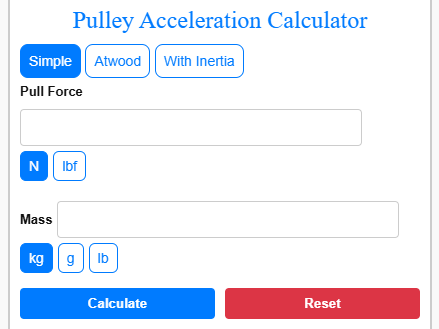
Understanding pulley acceleration is important when analyzing lifting systems, belt drives, or basic mechanical motion. This Pulley Acceleration Calculator allows you to evaluate how different forces and masses influence system movement under real working conditions. Whether you’re testing a simple pull force, studying an Atwood machine setup, or including pulley inertia for more realistic results, this tool helps visualize how acceleration changes.
It’s useful for students, workshop designers, and anyone working with motion systems.
How to Calculate Pulley Acceleration
Pulley acceleration depends on the forces acting on the system and whether the pulley is ideal (massless) or has its own mass and rotational inertia. Below are the three common cases used in mechanics.
Simple Force on a Mass
If a force pulls a single mass directly, acceleration is calculated using Newton’s Second Law:
Formula:
a = F / m
Where:
F = Force (N)
m = Mass (kg)
a = Acceleration (m/s²)
Example:
If F = 50 N and m = 10 kg:
a = 50 / 10 = 5 m/s²
Atwood Machine (Ideal Pulley)
For two masses connected over a frictionless, massless pulley:
Formula:
a = (m₁ − m₂)g / (m₁ + m₂)
Where:
m₁ = Heavier mass (kg)
m₂ = Lighter mass (kg)
g = Gravity (9.81 m/s²)
Example:
If m₁ = 12 kg and m₂ = 8 kg:
a = (12 − 8) × 9.81 / (12 + 8)
a = 39.24 / 20
a = 1.962 m/s²
Pulley with Moment of Inertia (Real Pulley)
If the pulley has mass and rotational inertia, acceleration decreases because rotational resistance must also be overcome.
Formula:
a = (m₁ − m₂)g / (m₁ + m₂ + I / r²)
Where:
I = Moment of inertia (kg·m²)
r = Pulley radius (m)
I / r² = Effective mass of pulley
Example:
If m₁ = 15 kg, m₂ = 10 kg, I = 0.5 kg·m², r = 0.2 m:
I / r² = 0.5 / (0.2²) = 0.5 / 0.04 = 12.5
a = (15 − 10) × 9.81 / (15 + 10 + 12.5)
a = 49.05 / 37.5
a = 1.308 m/s²
Key Understanding
• Larger mass difference → Higher acceleration
• Higher total system mass → Lower acceleration
• Adding pulley inertia → Reduces acceleration
• Larger pulley radius (with same inertia) → Increases acceleration
Pulley Acceleration Example Values
| Mode | Inputs | Acceleration (m/s²) |
|---|---|---|
| Simple | F = 50 N, m = 10 kg | 5.000 |
| Simple | F = 120 N, m = 30 kg | 4.000 |
| Atwood | m₁ = 12 kg, m₂ = 8 kg | 1.962 |
| Atwood | m₁ = 20 kg, m₂ = 15 kg | 1.401 |
| With Inertia | m₁ = 15 kg, m₂ = 10 kg, I = 0.5, r = 0.2 m | 1.308 |
| With Inertia | m₁ = 18 kg, m₂ = 12 kg, I = 0.8, r = 0.25 m | 1.635 |
Related Calculators: